How does LangChain compare to other AI agent frameworks?
How does LangChain compare to other AI agent frameworks?
 hahz
2 months ago
hahz
2 months ago
32
 hahz
2 months ago
hahz
2 months ago
How does LangChain compare to other AI agent frameworks?
When to Choose Alternatives
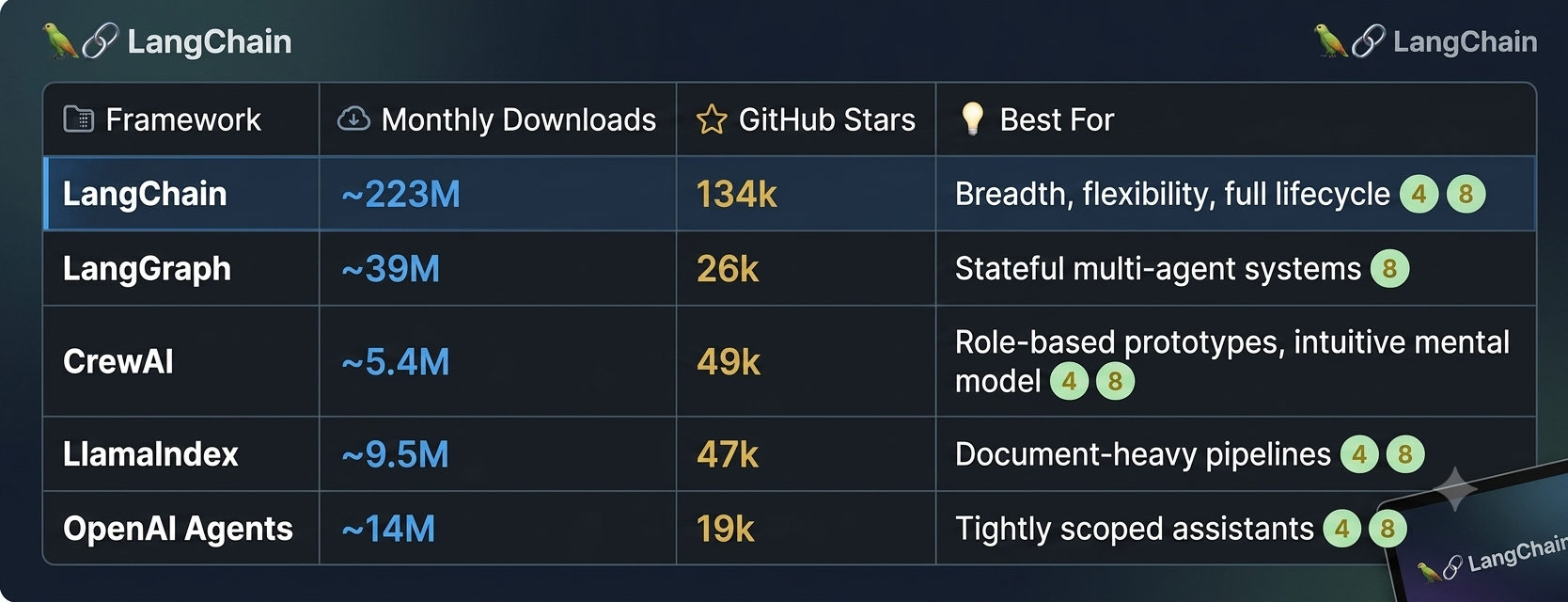
CrewAI: Teams that need a working multi-agent prototype quickly and whose workflows map naturally to distinct agent roles with clear task boundaries
Microsoft Agent Framework: Teams on the Microsoft stack wanting the unified successor to AutoGen and Semantic Kernel
LlamaIndex: Teams building document-heavy, data-intensive pipelines where event-driven orchestration is key
OpenAI Agents SDK: Teams needing tightly scoped assistants and clean multi-agent delegation with minimal abstraction
LangChain's Standout Advantages
Swap between OpenAI, Anthropic, Google Gemini, AWS Bedrock, and others without rewriting application logic. This is essential in a space where the best model for any given task changes regularly.
Full Lifecycle Platform
LangSmith provides observability, evaluation, and deployment across the entire application lifecycle. This systematic approach helps teams catch reliability issues before they become production incidents.
Massive Ecosystem
1,000+ integrations for vector databases, document loaders, tools, and APIs. This breadth means developers can build almost any use case without switching frameworks.
1.0 Stability
LangChain and LangGraph 1.0 mark major stability milestones with no breaking changes until 2.0. The package has been streamlined to focus on essential agent-building abstractions
LangChain is the most widely adopted AI agent framework with 223M monthly downloads—significantly more than any competitor. While frameworks like CrewAI (5.4M downloads) excel at role-based multi-agent prototypes and Microsoft Agent Framework (9.6k stars) fits well on the Microsoft stack, LangChain stands out for its flexibility, massive ecosystem, and production-ready tooling through LangSmith.
Notifications